How Can You Tell If an Air Conditioner Has a Refrigerant Leak?
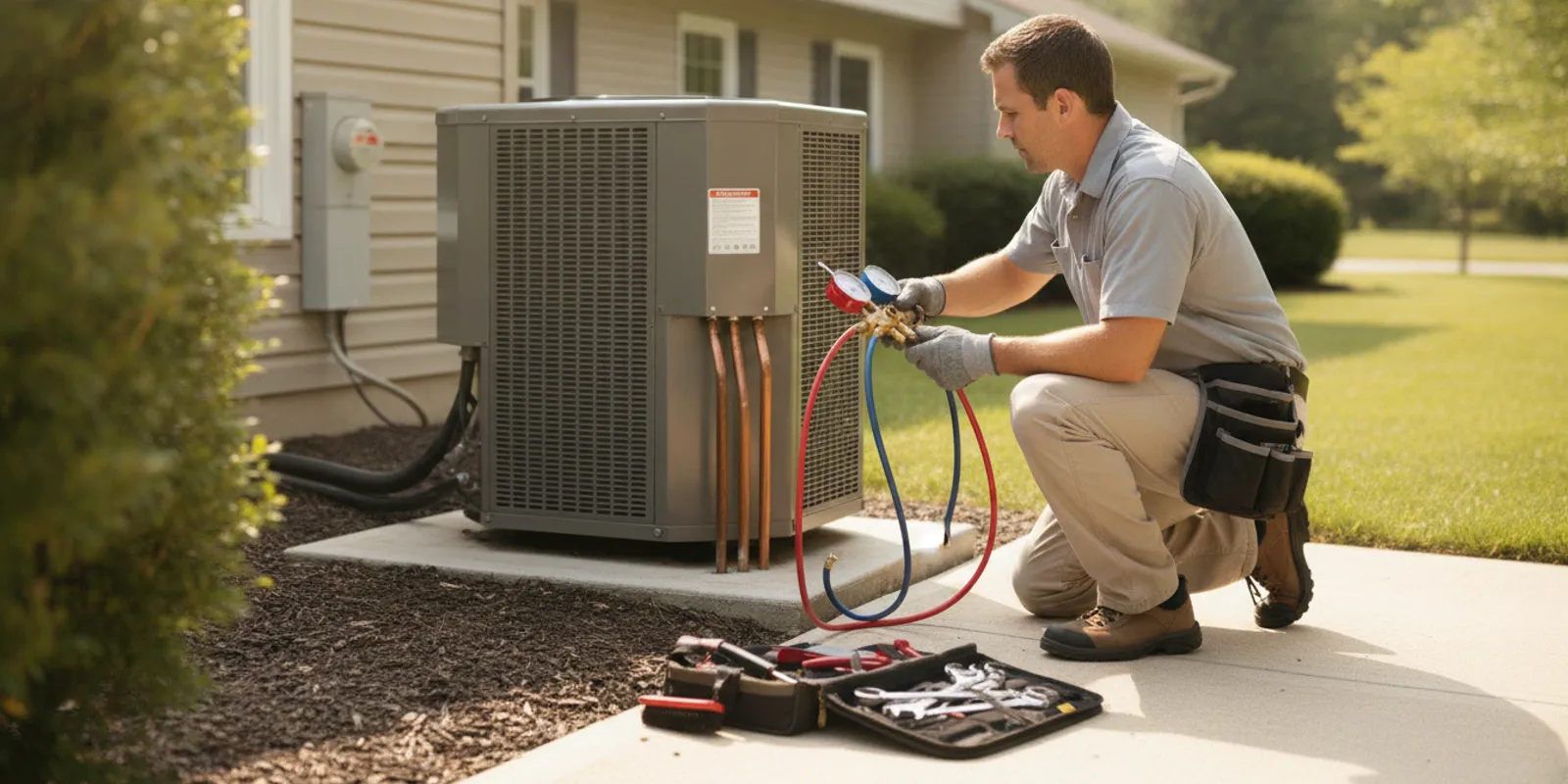
When a central air conditioner stops cooling well, a refrigerant leak is one possible cause, but not the only one. How can you tell if an air conditioner has a refrigerant leak? Look for a pattern such as weak cooling, longer run times, ice on the refrigerant line or indoor coil, or a hissing sound near the equipment. These signs are clues, not proof. A qualified HVAC professional needs to test the system and find the cause before anyone can confirm a leak.
What does refrigerant do in an air conditioner?
Refrigerant is the working fluid that moves heat through a cooling system. In a typical central air conditioner, it circulates in a closed path between the indoor evaporator coil and the outdoor condenser coil. As it changes pressure and state through the system, it absorbs heat from indoor air and releases that heat outdoors. The blower moves air across the indoor coil, while the outdoor unit transfers heat outside.
Refrigerant is not fuel that an air conditioner normally burns up. A system is designed to contain a set charge. If the amount is low, that can happen because refrigerant escaped through a leak, because of a previous service or installation issue, or because the system was not charged correctly. A technician must assess the system to distinguish among these possibilities. Adding refrigerant without addressing the reason for a low charge may provide only temporary improvement and can leave the underlying issue in place.
A refrigerant problem can also be confused with a dirty filter, restricted airflow, a thermostat setting, an electrical fault, or a failing component. That is why a single symptom should not be treated as a diagnosis. For general information about refrigerants and environmental programs, see the U.S. Environmental Protection Agency.
How Can You Tell If an Air Conditioner Has a Refrigerant Leak?
There is no one symptom that confirms a leak at home. Instead, notice whether several changes appear together and whether they persist after simple, safe checks. Common clues include:
- The house is not reaching the thermostat setting. The system may run for a long time while rooms remain warm or the temperature drops very slowly.
- Cooling seems weaker than usual. Air may still come from the vents, but the home does not feel as comfortable as it did under similar weather and operating conditions.
- The system runs for unusually long cycles. Longer operation can have many causes, including high outdoor temperatures, poor airflow, or an undersized or malfunctioning system. It is more useful as a clue when paired with other symptoms.
- Ice or frost appears on refrigerant tubing or the indoor coil. Low refrigerant may contribute to a coil becoming too cold, but blocked airflow can also cause ice. Frost is not a reason to chip at the equipment or keep running it.
- A hissing or bubbling noise comes from the equipment or line set. A sound can have several sources. If it is new and seems to come from the air conditioner, note where and when it occurs and tell the technician.
- Cooling performance changes over time. A gradual decline can be consistent with a developing issue, but it does not identify the cause by itself.
Pay attention to timing and context. Write down when the problem began, whether it is constant or intermittent, which rooms are affected, how long the unit runs, and whether you see frost or hear a new sound. If you have a thermostat that displays indoor temperature, note the setting and reading. These observations can help a service professional understand the complaint without requiring you to touch the equipment.
Which symptoms can look like a refrigerant leak?
Many cooling complaints overlap. Warm air or weak airflow can result from a clogged filter, a closed or blocked supply register, a dirty coil, a blower issue, a thermostat problem, or an electrical fault. Ice can form when airflow across the coil is restricted, even if the refrigerant charge is not the main problem. A system that runs constantly may be struggling with high heat, poor insulation, an open window, or another equipment fault.
That overlap is important because guessing wrong can waste time or lead to unsafe handling. A homeowner may safely check the thermostat mode and setting, make sure supply vents are not blocked by furniture, and inspect the air filter according to the equipment instructions. If the filter is visibly dirty and the manual identifies it as homeowner-serviceable, replace it with the specified type and size. Do not remove service panels, handle refrigerant tubing, or try to test pressures.
If the unit is frozen, switch cooling off rather than continuing to operate it. If the equipment instructions allow it, the indoor fan may be set to run to help thaw the coil, but do not use a heat source or scrape away ice. Thawing does not identify the cause or repair a leak. If ice returns, the system still needs diagnosis. For a broader overview of common cooling trouble, see this guide to AC repair problems and next steps in Barrington.
What should you check before calling for service?
A few non-invasive checks can rule out simple operating issues and make the service call more useful. Stay with controls and accessible items. If you are unsure whether a check is safe, skip it and request help.
- Confirm the thermostat settings. Check that it is set to cooling, the temperature is below the current room reading, and the fan setting is what you expect. Replace thermostat batteries only if the device uses them and its instructions recommend it.
- Look at the air filter. Follow the system manual for its location and replacement. A heavily loaded filter can reduce airflow. Do not operate the unit without a filter unless the manufacturer instructions specifically allow it.
- Check visible vents. Make sure supply registers and return grilles are not covered by rugs, curtains, boxes, or furniture. Do not close many vents in an attempt to force more air into other rooms.
- Observe the equipment from a safe distance. Note whether the outdoor unit appears to run, whether there is visible ice, or whether there are unusual sounds. Do not reach through the grille, remove a cover, or touch wiring or tubing.
- Record what happens. Note the time, outdoor conditions if known, thermostat setting, room temperature, run duration, and the rooms where comfort has changed. A brief timeline is more useful than a guess about the refrigerant level.
Do not open the refrigerant circuit, connect gauges, apply leak sealant, or buy a recharge kit. Refrigerant systems operate under pressure and require specialized equipment and training. Do not release refrigerant or attempt to repair a suspected leak yourself. If the system is making an alarming electrical noise, smells burnt, or has exposed wiring, stop using it if you can do so safely and seek professional guidance.
If basic thermostat and airflow checks do not explain the loss of cooling, an HVAC technician can assess the equipment. You can review Brilliant Home Services' air conditioning services or home service options to find the relevant service path.
How can a technician confirm a refrigerant leak?
A technician will first gather symptoms and inspect how the system is operating. The precise diagnostic steps depend on the equipment, the complaint, and what the initial checks show. A refrigerant leak should not be confirmed only by noticing ice, feeling warm air, or assuming a low charge from a single reading. The technician may assess airflow and system condition, inspect accessible components and connections, and use appropriate diagnostic methods to locate a suspected leak.
The inspection may also identify a different fault that produces similar symptoms. For example, restricted airflow can contribute to coil icing, while a control or electrical issue may prevent normal cooling. A careful evaluation matters because treating only the visible symptom may not restore reliable operation.
Ask the technician to explain what was found in plain language. Useful questions include:
- What evidence indicates that the system is low on refrigerant or leaking?
- Where is the suspected leak, and how was it located?
- Was another issue, such as airflow restriction or a component fault, found?
- What repair or replacement options are available, and what does each include?
- Will the system be checked after the work to confirm it is operating as intended?
Request an explanation before approving work if the diagnosis or proposed next step is unclear. Service needs and costs depend on the equipment, the location and severity of a problem, parts availability, and the repair approach. No one can provide a reliable repair recommendation from symptoms alone.
If you would like a professional to assess a cooling problem, schedule service with Brilliant Home Services.
What should you do if you suspect a refrigerant leak?
First, avoid treating the system as a do-it-yourself refrigerant project. If the air conditioner is still cooling poorly, repeatedly icing, or running much longer than usual, arrange an evaluation rather than repeatedly restarting it. If the indoor coil or line is iced, turn cooling off and let a professional advise you on the next step. Do not chip the ice away or use a hair dryer, heat gun, or other direct heat.
While you wait, keep a record of the symptoms and the simple checks you completed. Take a photo of visible ice from a safe position if useful, but do not remove equipment panels to get a better view. If cooling is limited to certain rooms, list them. If you recently changed the thermostat, filter, or operating schedule, note that as well. These details can help the technician focus the assessment.
When arranging service, share the system type if you know it, the age if available, any model information visible without removing a panel, and the main symptoms. Mention any past repair or recent installation work you know about. You do not need to identify the refrigerant or diagnose the unit before asking for help. For a local service discussion, use the contact and scheduling page.
For customers comparing cooling system questions, these related guides may also help: how AC sizing works, what to consider during AC installation, and how to compare an AC repair company. They cover different decisions; none can replace a diagnosis of a suspected leak.
How do the signs compare with other cooling problems?
The table below is a starting point for describing what you observe, not a diagnostic chart. The same sign can have more than one cause, and the equipment needs professional assessment when a persistent problem remains.
| What you notice | Possible explanations | Safe next step |
|---|---|---|
| Warm air or slow cooling | Refrigerant issue, airflow restriction, thermostat setting, electrical or mechanical fault, or high heat load | Check settings and accessible filter; record when cooling changed and arrange service if it persists. |
| Ice on a line or indoor coil | Low refrigerant is one possibility; restricted airflow or another operating problem may also cause freezing | Turn cooling off, do not scrape or heat the ice, and seek professional advice. |
| Long run times | Refrigerant problem, blocked airflow, extreme outdoor conditions, or equipment/system performance issue | Check that vents are clear and note run duration, indoor conditions, and thermostat setting. |
| New hissing or bubbling noise | Possible refrigerant-line issue, but sounds may come from other equipment components | Note the location and timing from a safe distance; do not open the unit. |
| One room is uncomfortable | Air distribution, duct, register, room exposure, or system issue; not necessarily a refrigerant leak | Check for blocked registers and tell the technician which rooms are affected. |
When should you arrange an HVAC assessment?
Arrange an assessment when cooling remains weak after checking basic settings and airflow, when a symptom repeatedly returns, or when you notice ice on the equipment. You do not need to wait until the system stops completely to ask for help. Persistent long run times or a clear change in performance are worth describing, especially when they occur with another sign such as frost or an unfamiliar sound.
If the home is still reasonably comfortable and there are no immediate safety concerns, you can share the symptoms and ask about the next available appointment. Explain if the issue is getting worse, if the system has stopped cooling, or if vulnerable occupants are affected by indoor heat. Those details help the service provider understand the situation. If the indoor temperature creates an urgent health concern, move to a cooler location and seek appropriate assistance rather than relying on the air conditioner to recover.
Turn cooling off if you see substantial ice or if operating the equipment appears to worsen the problem. Do not repeatedly switch the system on and off to test it. If you smell burning, see damaged electrical parts, or hear a concerning electrical sound, avoid touching the equipment and seek prompt professional guidance. For visible fire or immediate danger, follow emergency procedures.
When there is no urgent hazard, gather observations without delaying a needed call. You can check the thermostat and accessible filter, but a long list of homeowner tests is not necessary. Report what you know, what you do not know, and any action you took. A professional can decide which measurements or inspections are appropriate.
What patterns may help explain the symptoms?
How the signs appear over time can help you describe the problem, though it still cannot confirm the cause. A sudden change after the system has been working normally may point to a new fault, but it does not identify whether that fault involves refrigerant, airflow, controls, or another part. A gradual decline can also have several explanations. Tell the technician whether the change was abrupt, slow, or intermittent rather than trying to choose a diagnosis from the timing.
If cooling is weak throughout the home, note whether the blower is still moving air and whether the air feels different at every supply register. If only one or two rooms are affected, describe those rooms and whether their doors, windows, or vents are usually in a different position. Room-to-room differences may relate to air distribution or building conditions; they do not by themselves establish a refrigerant leak.
If you see ice, observe where it appears without touching the equipment. A patch of frost on an accessible line and a fully iced indoor coil are different observations, but neither lets a homeowner measure refrigerant or identify a leak location. Take a photo from a safe distance if it helps document what you saw. Note whether the ice was present while the system was running and whether it returned after cooling was turned off and the system thawed.
If the system seems to cool normally at some times and poorly at others, record when the change occurs. Note the indoor temperature, thermostat setting, whether direct sunlight or cooking adds heat to the rooms, and whether the outdoor unit appears to be operating. Intermittent symptoms may make a diagnosis less obvious, so a few precise observations are more useful than a broad description such as “it has been acting strangely.”
A new noise deserves context as well. Note whether it begins when the air conditioner starts, continues while it runs, or remains after the unit stops. Do not put your face near the equipment or try to locate a sound by opening a panel. If the noise is loud, accompanied by a burning smell, or associated with visible damage, stop using the equipment if safe and ask for prompt professional guidance.
What is the difference between a leak repair and a refrigerant recharge?
A recharge means adding refrigerant to a system; it does not, by itself, explain why the charge was low or establish that the system is repaired. If refrigerant escaped, the leak needs to be identified and addressed as part of a sound plan. A technician should explain whether the charge was found to be low, what evidence supports that conclusion, and what action is proposed to restore operation.
Not every suspected leak can be repaired in the same way. The location, accessibility, condition of the affected component, equipment design, parts availability, and overall system condition can influence the options. Ask whether the recommendation is to repair a specific leak, replace a component, or consider a larger system decision. Request an explanation of what each option includes and what it does not promise.
It is reasonable to ask what will happen after the repair. The answer may include checking that the repair was completed, evaluating system operation, and explaining any remaining limitations. Ask what signs should prompt a follow-up call and whether the proposed work includes a return visit or any other verification. These questions keep the conversation focused on the actual scope rather than an assurance that a recharge alone will permanently resolve the issue.
There is no universal point at which replacement is automatically better than repair. The age and condition of the equipment, cost and scope of the repair, history of previous issues, and household priorities all matter. Compare written options based on the work and expected result described, not just the immediate price. If the diagnosis is unclear, ask for clarification before authorizing additional work.
How should you prepare for the service visit?
A little preparation can make the visit more focused without requiring you to diagnose the equipment. Start with a short timeline: when cooling first changed, whether the problem arrived suddenly or gradually, and what the system has done since. If you have noticed a sound or ice, write down where it appeared and whether it went away when the unit stopped. Record the thermostat setting and whether the indoor temperature moved toward it. Include any recent changes to the filter, thermostat, or household schedule that may help explain the timing.
Keep the equipment area accessible if you can do so safely. Move ordinary household items away from the outdoor unit, but do not take off its cover or move landscaping equipment around it while it is running. Make sure the path to the thermostat and indoor equipment is clear. If you rent or manage a property, confirm who can authorize service before the appointment. These practical details can reduce delays without adding risk.
When discussing the issue, describe the observations rather than telling the technician that the refrigerant is definitely low. For example, say, “The air from the vents has felt warmer for three days, the system runs for long stretches, and I saw frost on the larger insulated line yesterday.” That gives the technician useful evidence while leaving the diagnosis open. Mention if the symptom changes during the day or appears only in one part of the home.
Ask what the evaluation will cover before work begins. You can request an explanation of the test results, the location of any suspected leak, the proposed repair, and how the system will be checked after that repair. If the technician identifies a non-refrigerant cause, ask how it accounts for the symptoms you reported. A clear answer helps you understand the next step and distinguish diagnosis from repair recommendations.
There may be more than one reasonable path depending on the equipment's age and condition, the location of a leak, repair feasibility, and the cost of parts and labor. A small accessible repair and a problem involving a major component are not the same decision. Ask for the scope and limitations of each option instead of relying on a general promise that a recharge will solve the issue. A quote should describe the work being proposed, not just repeat a suspected symptom.
After service, note what work was completed and any operating guidance you received. If cooling does not improve or the same signs return, contact the service provider and describe what changed after the visit. Keep invoices and equipment records with the home documents; they may help future technicians understand the system's history. This follow-up is useful whether the cause was a leak, airflow, controls, or another component.
Could continued use make the problem worse?
Continuing to run an air conditioner that is not cooling properly may not solve the underlying problem. If the system is icing, operation can maintain the conditions that produced the ice and prevent normal assessment. If the equipment is cycling unusually, making unfamiliar noises, or failing to cool, repeated resets are not a substitute for diagnosis. Turn the system off if the manual or a technician recommends it, especially when ice is present.
At the same time, do not assume every cooling problem is an emergency. A warm home on a very hot day can be uncomfortable, but urgency depends on the conditions in the home and the people affected. If indoor temperatures create a health concern, make a plan to reach a cooler place and contact an appropriate service provider. For an electrical smell, visible damage, or another immediate safety concern, prioritize safety and avoid contact with the equipment.
Good service planning starts with the observations you can make safely, not with opening the unit. If a technician confirms a refrigerant problem, ask what repair is needed, what it will address, and how the system will be evaluated afterward. If a different problem is responsible, understanding that diagnosis helps avoid paying for work that does not address the actual cause.
Frequently Asked Questions
Can I tell for sure that refrigerant is leaking by looking at ice?
No. Ice can accompany a refrigerant problem, but restricted airflow and other faults can also cause a coil to freeze. Turn cooling off if ice appears, avoid scraping or heating it, and have the system evaluated if the issue persists or returns.
Does an air conditioner use up refrigerant over time?
A properly operating air conditioner circulates refrigerant in a closed system; it is not intended to use refrigerant like fuel. A low charge calls for investigation. A technician can determine whether there is a leak, a prior service issue, or another explanation.
Should I add refrigerant myself?
No. Do not connect a recharge kit, open the system, or release refrigerant. These tasks require appropriate training and equipment. Adding refrigerant without identifying and addressing the cause of a low charge may leave the problem unresolved.
What information should I have ready when I request service?
Describe what changed, when it began, whether the system runs continuously or cycles, which rooms are affected, and whether you noticed ice or a new sound. Share the thermostat setting and any simple checks you made. You do not need to know the refrigerant type or confirm that a leak exists.
What is the next step if you suspect a leak?
Weak cooling, long run times, ice, or an unfamiliar sound can all justify a closer look, but none proves that refrigerant has escaped. Check only accessible settings and airflow items, stop cooling if the equipment is frozen, and arrange a professional assessment if the problem continues. A clear description of what you observed is the safest and most useful starting point.
Ready to Get Started?
Contact Brilliant Home Services for professional, reliable service in Chicagoland. We are available 24/7 for emergencies.